Everything you need to know about hedging season
Updated: Aug 20, 2025

With only 2 weeks left until the end of August, it is official… Hedging Season is nearly here!
Whilst hedgerows might seem to easily blend into the background of our lives without much thought here at Siromer Tractors we disagree!
Not only are hedgerows an emblematic feature of the beautiful UK landscape, an incredibly important asset for farming, but also a home to much of our native wildlife.
In fact, we love hedges so much that we have dedicated this blog post to discuss everything hedgerows and hedging season from the legal guidelines to our top tips to keep your hedges beautiful and healthy this season.

What is hedging season?
Hedging season is the time of year in which it is legal to once again trim your hedges in the UK. This season extends from August 31st to the 1st of March.
Trimming hedges is very necessary to keep roads clear, boundaries correct and to keep hedges nice and healthy.
For example, did you know that regular trimming of boundary hedges helps improve their ability to capture pollution and block traffic noise?
However, this still does not explain why there is a law to prevent summer trimming. The real reason is one of our favourite reasons here at Siromer – and that is nature conversation.

Why do we have hedging season?
From March-August hedges are busy places for our native avian species being used to incubate their eggs, and then subsequentially raise their babies within the hedgerow. Hedges actually form the perfect habitat for these young birds as due to their bushy leaves and dark interiors, visibility inside is poor and hatchlings remain hidden. Because of this, within the confines of the hedgerows eggs and chicks remain unbothered from natural predators who they otherwise would have very little defense against.
However, this secluded living space also has a downside.

Much as the view of the nests is hidden from predators, it is also hidden from us. This means, especially if working with large equipment from far away, it is really easy to stumble across, and potentially disrupt or hurt a nest whilst cutting your hedge.
Because of this The Wildlife and Countryside Act of 1981 set in place a new law:
“You must not cut or trim a hedgerow that is covered by the rules from 1 March to 31 August. You must not cause or permit another person to cut or trim such a hedgerow.” (GOV UK https://www.gov.uk/guidance/hedgerow-management-rules-cutting-and-trimming)
because, according to section 1 of the same act, it is illegal to
“intentionally damage or destroy an active nest”.
In order to protect the diodiversity of birds and other creatures within the UK the law was enacted and has remained ever since.

It is worth noting however, that even during hedging season where birds theoretically won’t be nesting in your hedge, it is important to still check carefully before trimming just in case.
Some signs to look out for to suggest that there might be birds in your hedgerows are:
1. If you see birds flying frequently in and out of the hedge itself.
2. You see an actual nest. And whilst this nest could be old and dormant it is important to continue observing to see if any wildlife occupies this
3. If you see any building materials commonly used to make nests e.g twigs, grass, leaves and feathers
4. Some birds favour constructing their nests on the ground so make sure not to forgot to check high and low for any signs of life.
If you suspect that an offence has or is being committed against the wildlife and countryside act then it is encouraged to report this to your local Police Force and to then ask this case to be investigated by a Wildlife Crime Officer.
Like all laws there are further technicalities, intracacies and exceptions to the rule. To read more in depth about the legislation please read here.
Please note, farmers must also adhere to any agri-enviromental schemes and the Hedgerows Regulations of 1997 which are once again in place to help biodiversity.

Top tips to keep your hedges tip top!
Before beginning to trim your hedge it is important to know what your aims are to know how often, how aggressively and the science behind why you should be trimming your hedge.
Hedge trimming can be divided into 2 distinct categories:
1. Maintenance Trimming.
This is done to help shape the hedge itself and therefore the focus is on restricting its growth. This is not only helpful in reducing the hedges size to prevent encroaching beyond land limits, but also for aesthetic reasons. Maintenance trimming is typically only needed once a year, although depending on the species may be needed up to 3 times in one year for fast-growing topiary and/or formal hedges.
2. Formative Pruning.
In contrast, formative pruning is any cutting that is done to actually help promote future hedge growth and health. By removing any dead or diseased leaves, not only does this reduce spreading infection, but also encourages new and healthy growth for the coming year. By cutting old and dying parts of the plant it allows the plants full energy expenditure to go toward growing more leaves rather than maintaining a dying structure. In light of this, formative pruning may actually be helpful to cause a hedge to bloom flowers or fruit with their newly freed up energy stores. This formative pruning will also encourage bushy growth and a large framework of branches filling out the inside of the plant. Young or newly planted hedges need formative pruning once a year until they are around 5 years old and this pruning will help to keep the hedge healthy and strong in the long-run.

When is best to trim your hedges?
Winter or early spring is a great time to do your hedging as the fallen leaves will allow you to see the inside structure of the hedge making it much easier to identify where work is needed.
However, make sure to avoid pruning in extreme heat or cold as frost can easily damage freshly cut branches, while heat is prone to stressing the plant making it more vulnerable to pests and disease in the long run.
It is also important to ensure post prune that all hedges are well watered and fertilized to ensure maximum regrowth. This is especially important if the season you have done your hedging in is very dry.
For more information about when different species should be cut please look here.

How to trim your hedges:
1: The first and most important step is to simply visually assess the hedge to see which bits need doing and how to go about in this process. For example, potentially your hedge may only need light trimming (a light form of pruning that will only remove growth less than a year old) in which case trimming hand shears will work best. Whereas for large and more extensive work in something like a smallholding we would recommend machinery to save you a lot of time. No matter what you use ensure that your tools are sharp to encourage healthy regrowth.

2. Prepare the area for trimming. Make sure you are using safety gear, double check there are no bird nests inside, and think about the shape and size you would like your hedge to be.
Another helpful tip is to place tarpaulin under your hedge to allow for quick and easy clean up afterwards.
3. Make sure to cut the sides first. This will make it easier to judge the final size. It is important to monitor your cutting to make sure hedges do not end up wider at the top than at the base as this will prevent light, and therefore healthy growth, reaching these lower sections.
4. Now it is time to cut the top. At times keeping this level can be difficult to do, however if you are using something like a Siromer trimmer this will make your life a lot easier as the machine will help to keep the lines even.

5. Make sure to regularly stand at a distance to check the progress of your hedging and that everything is the correct size and shape.
6. Once you are done make sure to clear away any trimmings. These trimmings may fit in your green council bin if your hedges are small, but if not they make great compost!
What equipment to use
So that leads us nicely on to our final section, what equipment is best to use for my hedging?
Siromer has a full selection of hedge trimmers to fit every job and every need here.

The benefit of using machinery to trim your hedgerows is that without doubt you will save a massive amount of time and energy.
Whilst hand trimming works well for very small or delicate jobs, if you have large hedgerows across your smallholding then working without a machine can be incredibly laborious. In these circumstances machinery not only takes away from the monotony of what can be quite a boring task, but also gives you the gift of using the time you would have used trimming hedges to put to something you would love like spending time on your hobbies, with your friends or families, or just simply relaxing.
Here at Siromer we think 2025 is the year to work smart, not hard. So why not treat yourself and get a piece of machinery to take the load off?

Take the F61 Finger Bar (found online here).
This lightweight hedge trimmer flies like a butterfly and stings like a bee. With its compact size and 1.9m cutting head, this finger bar has an impressive vertical reach of 5.2m and a horizontal reach of 4.9m. It can even cut on top of a 2.65m hedge!
Using the PTO to drive, this finger bar has the ability to cut both on the left and right hand side, and its fitted double hydraulic pump means that the head can keep oscillating whilst being adjusted. Our F61 Finger Bar is designed with precision in mind, so this one is for the real Davinci’s out there!

Or perhaps the G42 Hedge Trimmer will tickle your fancy. With a horizontal reach of 4.5m and a vertical reach of 4.9m this high-powered piece of kit is sure to work on any sized hedge! And if that wasn’t good enough, the G model hedge trimmer comes available in 3 different models- the G41, the G42 above and the very powerful G43 which has an impressive max reach of 5.5m by 5.7m. To check out these models online please follow our link here.

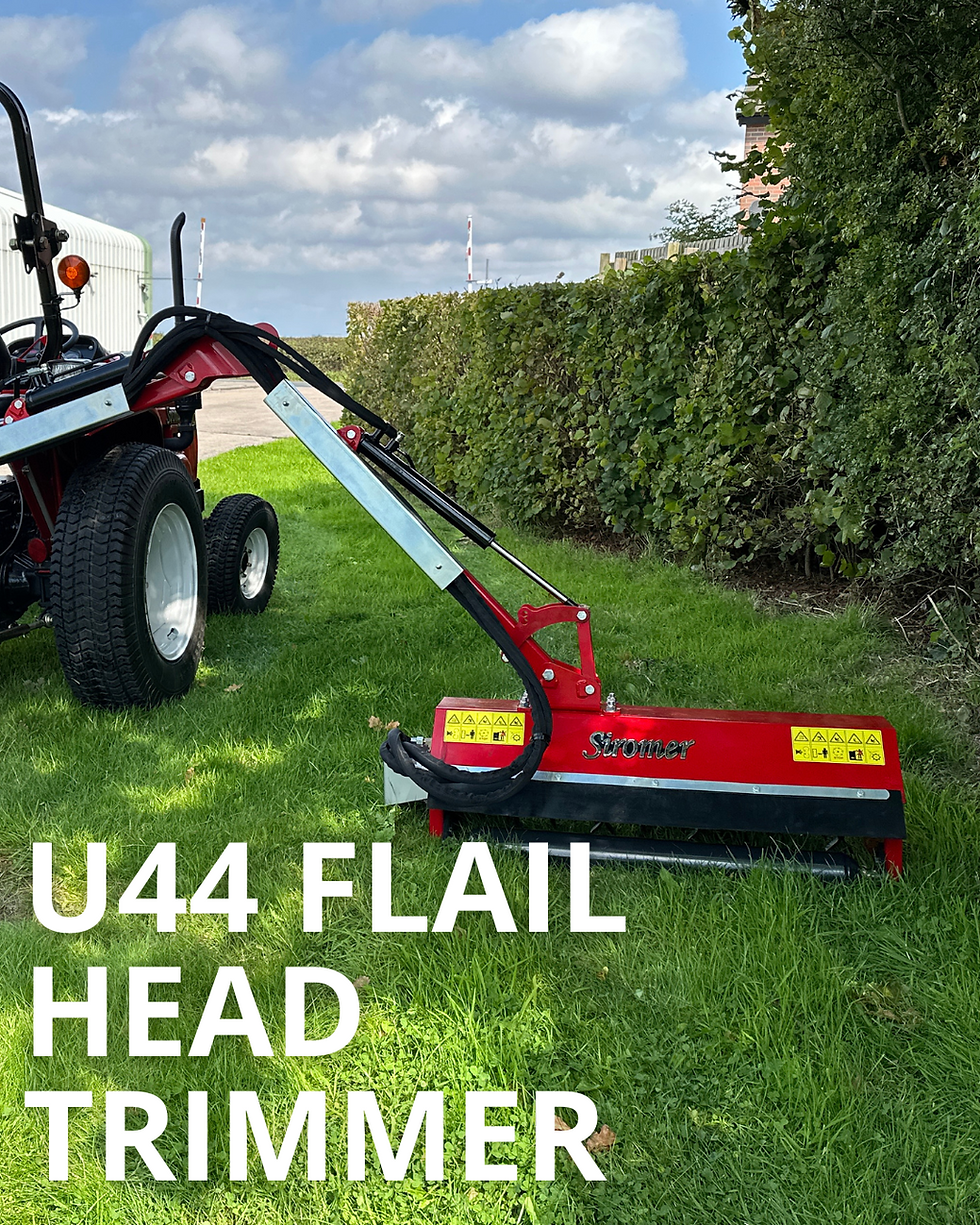
Or if you are looking to tackle rougher, overgrown hedges then the U44 Flail Hedge Trimmer is for you. Available in 4 different models: The U43 Flail Head, The U44 Flail Head, the U45 Flail Head and the U54 Finger Head there is something for everyone.
And with cutting widths from 600mm all the way up to 1300mm you cannot go wrong!
To see our full collection please check out our website here.
And last but certainly not least, we have the F50 FEL Hedge Trimmer available here.
This front-end loader hedge trimmer has many advantages such as simple operation, low noise, and it’s lightweight build.
It is also incredibly adaptable as it can be fitted to tractors (normal and compact), yard loaders (as well as wheel loaders), and front loaders using Euro adaptors or by using pallet forks.

So, whether you are looking for fine precision, pure power, lightweight compact machinery, or versatility throughout your smallholding, Siromer has the solution for you!
To speak to a member of our expert team about what machinery might work best for your land and hedge trimming needs, please give us a ring on 01253 799029 or pop us over an email at tractors@siromer.co.uk.
And to conclude, don’t worry if you don’t have everything ready for your hedging season this year, you still have until the end of February! In the meantime, we wish you all the luck with trimming your hedges.
👉 Next up: Hedgecutting Safety: Protecting You, Your Tractor, and the Wildlife - our guide to making sure you, your kit, and your hedges are kept in top condition this season.